What are space images and how are they different?
Space images, or satellite images, are images of the Earth's surface obtained using sensors installed on orbital platforms. They are widely used in cartography, environmental monitoring, agriculture, urban planning, and scientific research.
The key characteristics of satellite data are spatial resolution (pixel size), spectral resolution (number and type of spectral bands), and temporal resolution (repeat interval).
The most widely used open satellite datasets today are Landsat and Sentinel, but they address different objectives.
Landsat is the longest continuous Earth observation program. Its archive dates back to 1972, making Landsat indispensable for analyzing long-term land cover changes, urbanization, and natural processes. The spatial resolution (typically 30 m) and sensor stability ensure data comparability over time.
Sentinel is focused on rapid and detailed monitoring. Sentinel-2 offers higher spatial and temporal resolution, which is especially important for analyzing vegetation, agriculture, and urban environments. Sentinel-1 uses radar imaging (SAR), allowing data to be acquired regardless of cloud cover and lighting conditions.
In practice, Landsat is more often used for retrospective analysis and time series construction, while Sentinel is used for monitoring current changes and tasks requiring high detail.
Main Categories of Satellite Data Sources
Space imagery sources can be roughly divided into several groups. The first are government and scientific programs, such as NASA, ESA, and USGS, which provide large archives of openly accessible data. The second group includes international open data initiatives focused on climate, environmental, and natural resource monitoring.
Commercial satellite imagery providers deserve special mention. They offer ultra-high-resolution data, but in most cases, they require a fee. Finally, aggregators and catalogs play an important role, allowing data to be searched across multiple missions and archives simultaneously.
Open Sources of Space Imagery
For ease of use, all sources of satellite imagery can be divided into two fundamentally different categories: official data archives and web portals for viewing and analysis. This division helps you quickly choose the right tool—for downloading raw data or for quick visual analysis.
Official Satellite Data Archives
These sources provide access to raw satellite data and are designed for further processing in GIS or analytical platforms.
USGS EarthExplorer
One of the most comprehensive satellite data archives. The primary source of Landsat data, with a continuous observation archive dating back to 1972, as well as Sentinel, ASTER, NAIP, and other missions.
Copernicus Data Space (ESA)
Official data archive of the Copernicus program. Provides access to Sentinel-1 (SAR), Sentinel-2 (optical), and Sentinel-3 data, focused on operational monitoring of the Earth's surface.
NASA Earthdata
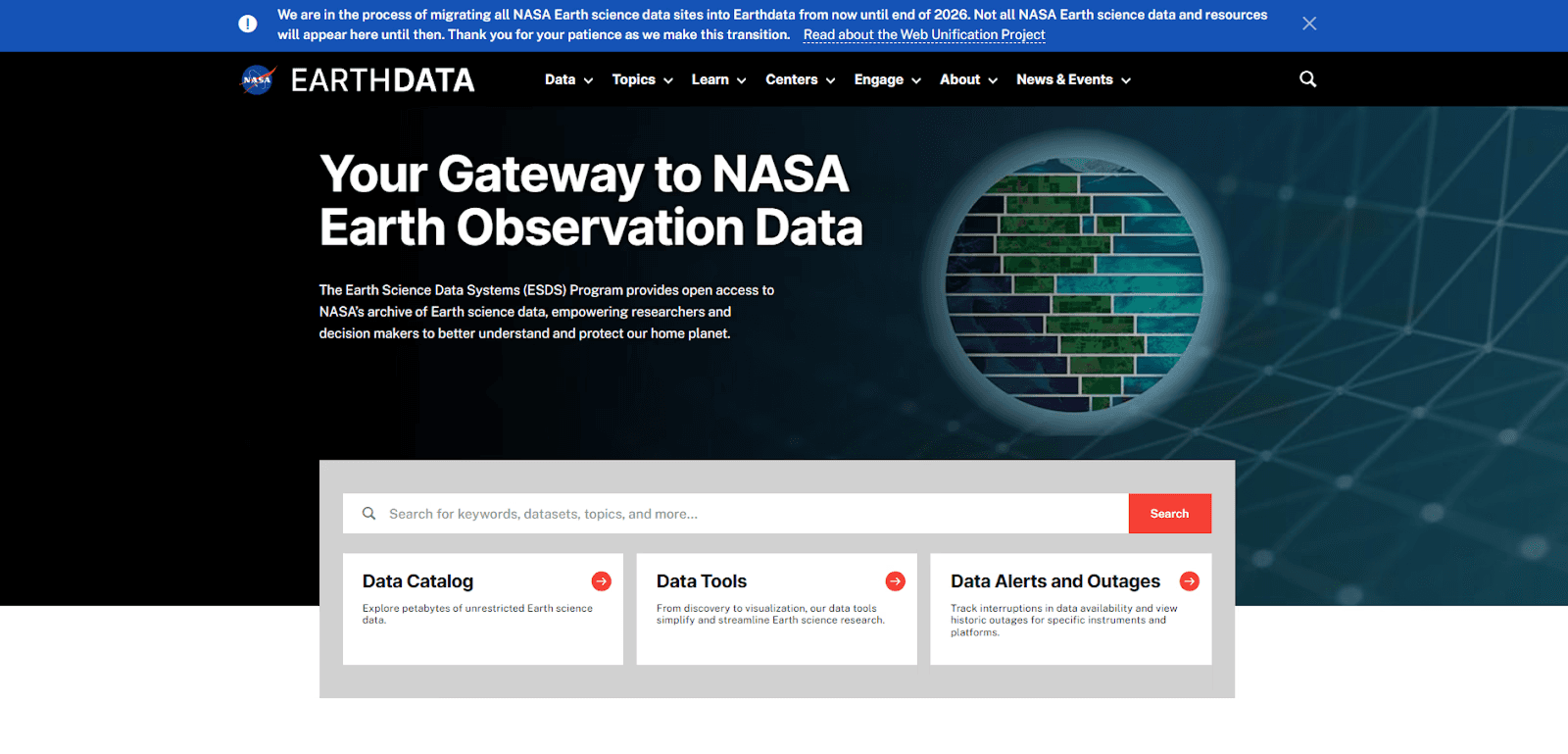
Open portal for accessing global satellite imagery and Earth observation data.
A centralized archive of NASA satellite and climate data, including MODIS, VIIRS, and ASTER, widely used for global and long-term research.
NOAA CLASS
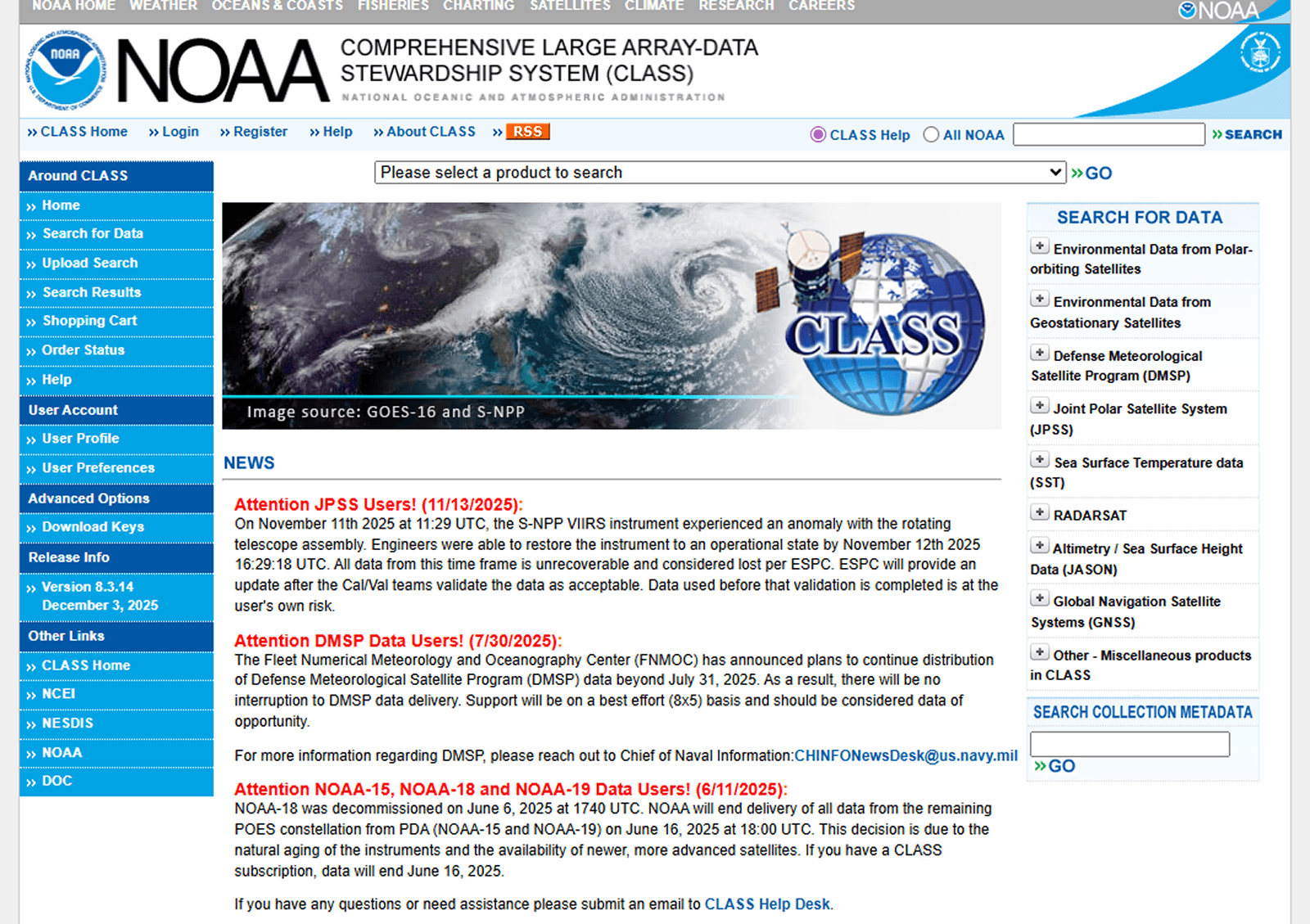
Portal website specialized in meteorological and climate satellite data rather than general-purpose land imagery.
An archive of NOAA meteorological and oceanographic satellite data used to analyze climate and weather processes.
JAXA G-Portal
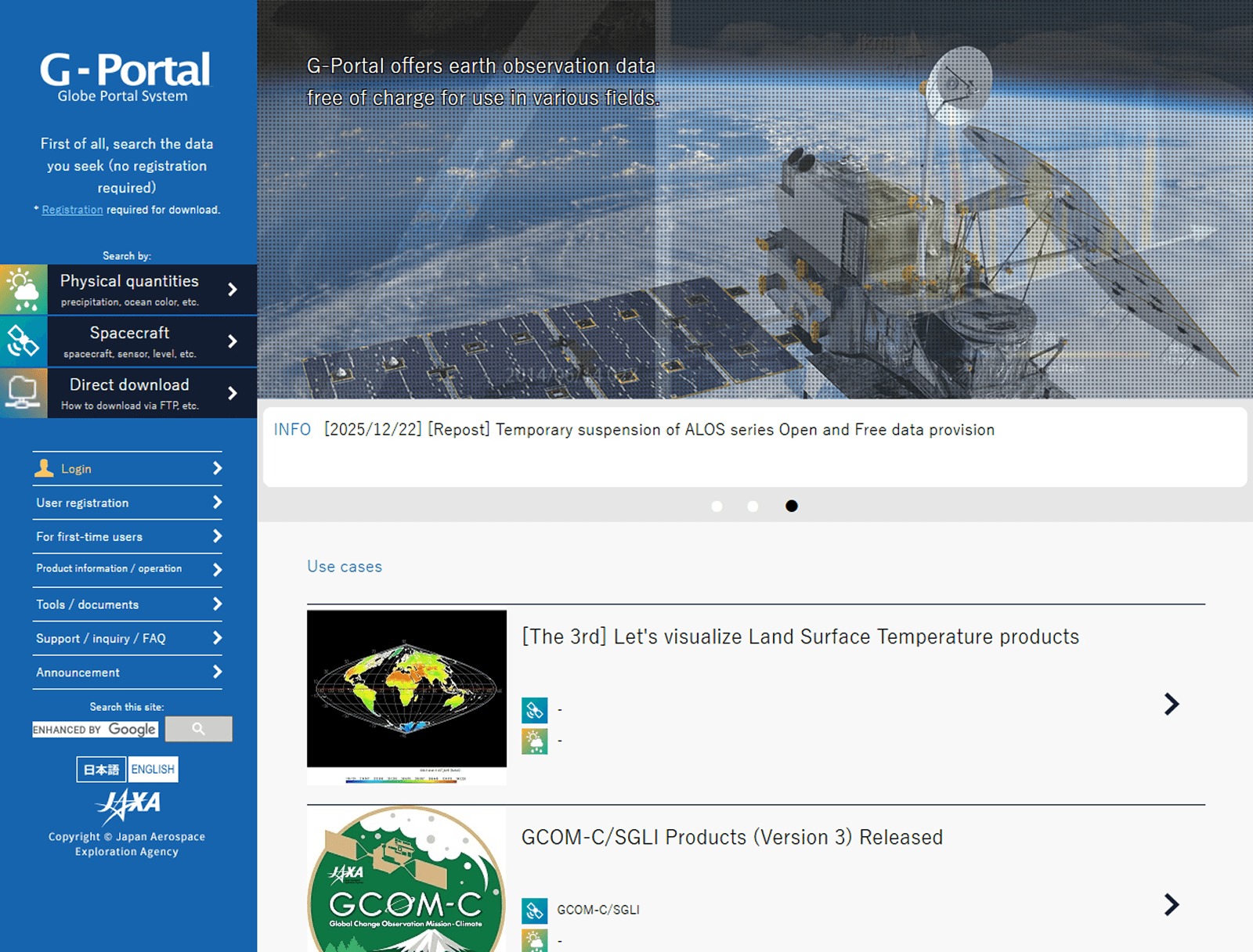
Portal website providing access to Japanese satellite missions.
The official archive of data from Japanese satellite missions, including optical and radar (SAR) data, such as ALOS.
Web Portals and Visualization Services
These tools are designed for quick viewing, initial analysis, and work without downloading large volumes of data.
Google Earth Engine Data Catalog
A cloud-based catalog of satellite data (Landsat, Sentinel, MODIS) designed for analyzing time series and large areas without local data storage.
EOS Landviewer
A web platform for interactive viewing and analysis of Landsat and Sentinel satellite imagery with basic preprocessing and visual customization.
ESA WorldCover
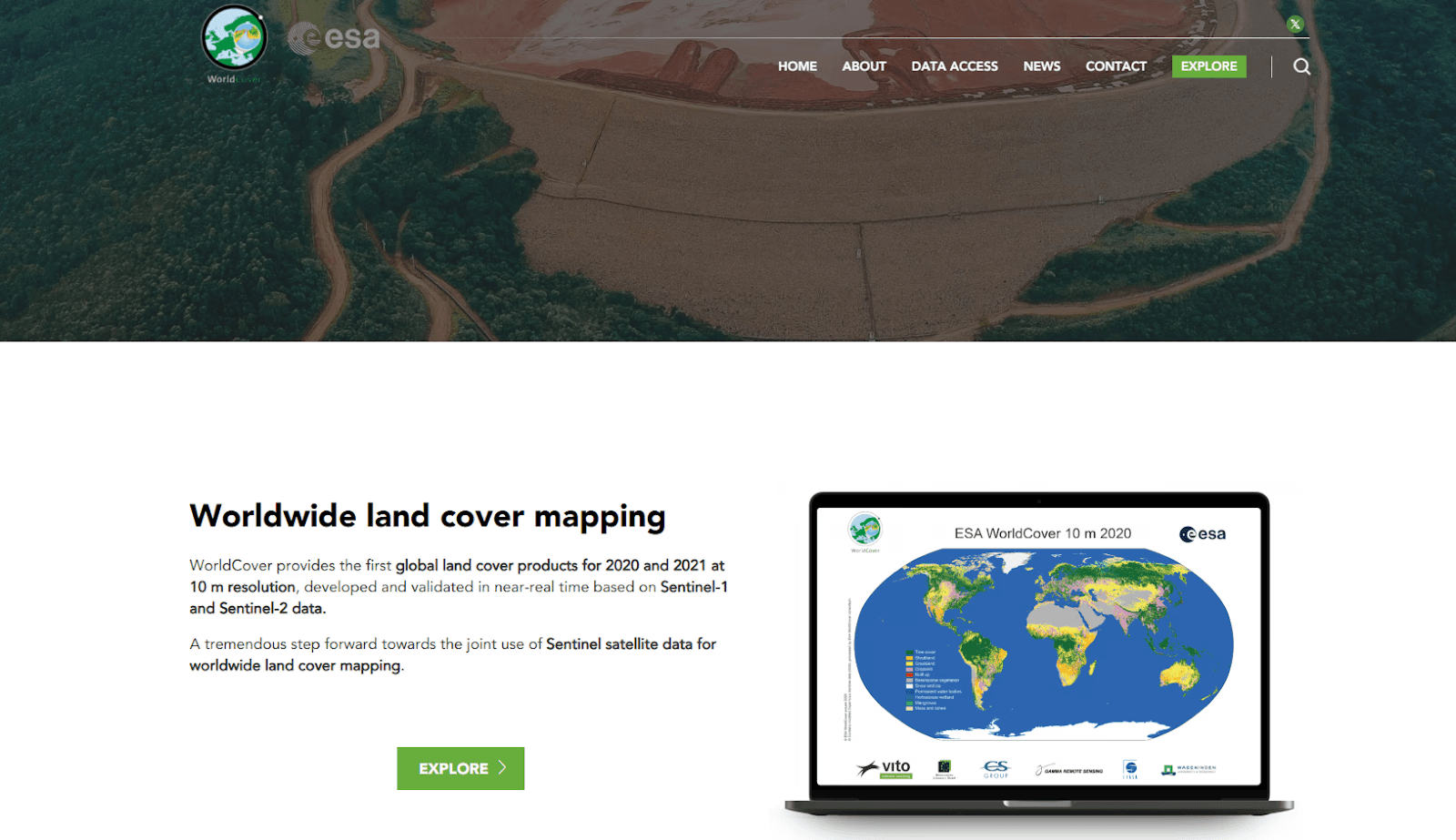
Portal website offering a ready-to-use global land cover product for fast mapping and analysis.
A global land cover product based on Sentinel-1/2 data, designed for quick use in GIS and web mapping.
How to choose satellite imagery for a task
For analytical projects, time series, and reproducible results, it's best to use official data archives such as USGS EarthExplorer, Copernicus Data Space, and NASA Earthdata. These sources provide raw data with complete metadata, long-term coverage, and stable processing levels, which is critical for change monitoring and scientific research.
Web portals and online services are convenient in the early stages of work and for rapid analysis. Platforms like Google Earth Engine and EOS Landviewer allow you to quickly view imagery, compare different dates, and assess data quality without downloading large volumes of data.
Comparison of open satellite imagery sources
Source | Main missions | Spatial resolution | Years of coverage | Free / paid | Access format | Best use cases |
USGS EarthExplorer | Landsat, ASTER, Sentinel | 10–30 m | 1972 – present | Free | Download | Long-term land cover change, baseline mapping |
Copernicus Data Space (ESA) | Sentinel-1 / 2 / 3 | 10–20 m | 2014 – present | Free | Download | Operational monitoring, vegetation, urban areas |
NASA Earthdata | MODIS, VIIRS, ASTER | 250 m – 1 km | 1999 – present | Free | API / download | Climate, environmental and global studies |
NOAA CLASS | GOES, POES, JPSS | 500 m – several km | 1970s – present | Free | Download | Weather and climate analysis |
JAXA G-Portal | ALOS, ALOS-2 | 10–30 m | 2006 – present | Free | Download | SAR analysis, terrain and natural hazards |
Google Earth Engine | Landsat, Sentinel, MODIS | 10 m – 1 km | Depends on mission | Free* | Cloud processing | Time series, large-scale analysis |
EOS Landviewer | Sentinel, Landsat | 10–30 m | 1980s – present | Free / paid | Web interface | Fast visual inspection, on-the-fly analysis |
Key Takeaways
Landsat is chosen for analyzing long-term changes, while Sentinel is used for up-to-date and detailed monitoring.
The spatial resolution and imaging period should be consistent with the scale of the task, not the maximum capabilities of the data.
Open satellite archives cover most practical GIS tasks without the need for commercial sources.
FAQ
Where do I start searching for satellite imagery?
The best place to start is with large portals such as USGS EarthExplorer or Copernicus, which combine data from multiple missions.
Can open satellite data be used in commercial projects?
In most cases, yes, but it is always important to check the license for a specific dataset.
When is commercial satellite imagery needed?
Commercial data is required for tasks where ultra-high resolution or rapid imaging is critical.