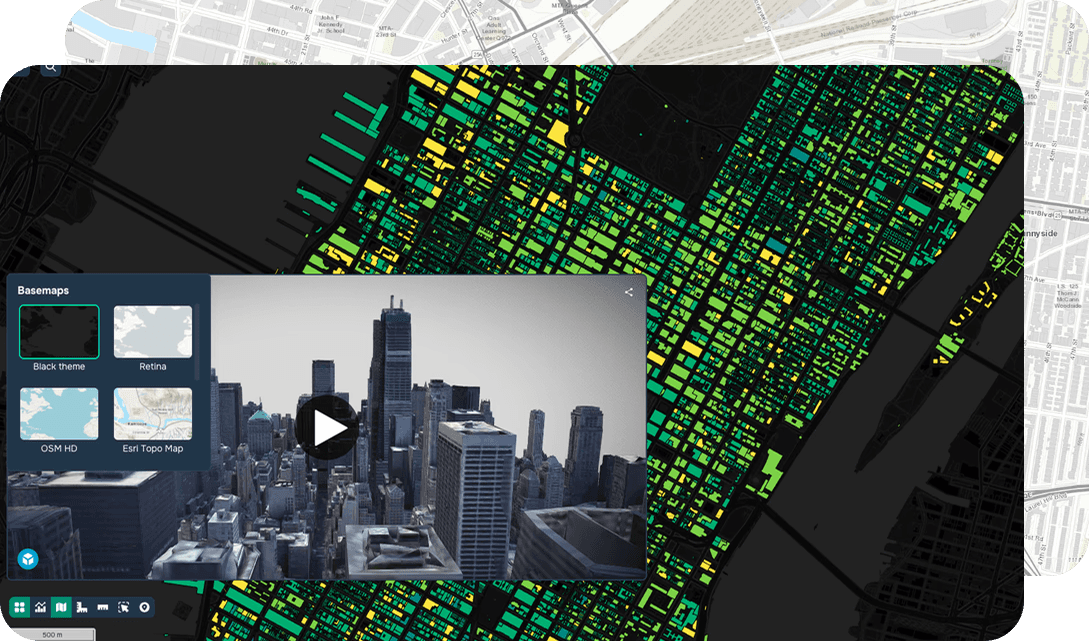
Demographics Research
Definition
Demographics research within a GIS context involves the collection, spatial analysis, and visualization of population-related data — including age distribution, income levels, ethnicity, household composition, and migration patterns — across defined geographic areas. GIS technology enables analysts to integrate census data, survey results, and socioeconomic datasets into layered geospatial frameworks, transforming raw statistics into actionable spatial intelligence.
Using tools such as choropleth mapping, spatial autocorrelation, and hotspot analysis, GIS professionals can identify population clusters, detect demographic shifts over time, and uncover correlations between geographic variables and human behavior. Geospatial data from sources like the U.S. Census Bureau, OpenStreetMap, and satellite imagery can be overlaid with administrative boundaries, transportation networks, and land use classifications to produce high-resolution demographic profiles.
The practical benefits are extensive. Urban planners leverage demographic mapping to guide infrastructure investment and zoning decisions. Retailers use population density analysis for site selection. Public health agencies apply spatial analysis to target underserved communities. Ultimately, GIS-powered demographics research converts complex population data into clear, location-based insights that support evidence-driven decision-making across both public and private sectors.
FAQ
What is demographics research in GIS?
Demographics research in GIS involves collecting, analyzing, and visualizing population-related data — such as age distribution, income levels, ethnicity, and migration patterns — across defined geographic areas. GIS technology integrates census data, survey results, and socioeconomic datasets into layered geospatial frameworks, transforming raw statistics into actionable spatial intelligence. This approach enables analysts to build high-resolution demographic profiles tied directly to real-world locations.
How is GIS applied to demographics research?
GIS professionals use tools such as choropleth mapping, spatial autocorrelation, and hotspot analysis to identify population clusters, detect demographic shifts over time, and uncover correlations between geographic variables and human behavior. Geospatial data from sources like the U.S. Census Bureau and OpenStreetMap can be overlaid with administrative boundaries, transportation networks, and land use classifications. This multi-layer approach converts complex population data into clear, location-based insights.
What are the practical benefits of using GIS for demographics research?
GIS-powered demographics research supports evidence-driven decision-making across both public and private sectors by providing precise, spatially referenced population insights. Urban planners use demographic mapping to guide infrastructure investment and zoning decisions, retailers apply population density analysis for site selection, and public health agencies leverage spatial analysis to identify and target underserved communities. These capabilities make GIS an essential tool for organizations that rely on understanding where people live, move, and interact.
What data sources and technical methods are commonly used in GIS demographics research?
Common data sources for GIS demographics research include U.S. Census Bureau datasets, OpenStreetMap, satellite imagery, and proprietary socioeconomic surveys, all of which can be integrated into a unified geospatial framework. Technically, analysts often work with vector and raster data formats, applying spatial joins and kernel density estimation to merge and analyze datasets across geographic boundaries. Implementing standardized coordinate reference systems and maintaining data currency are critical best practices for ensuring accurate, reproducible demographic analysis.