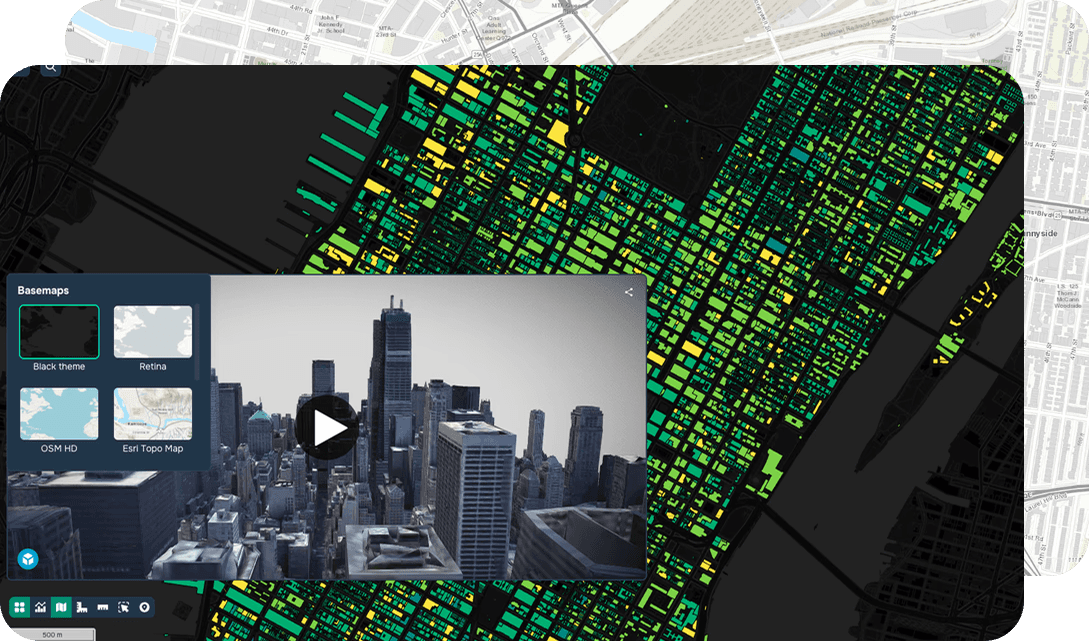
Social Media Mapping
Definition
Social media mapping is a GIS use case that involves the collection, integration, and spatial analysis of user-generated content from social media platforms to derive geographically referenced insights. By leveraging geotagged posts, check-ins, and location-enabled metadata, geospatial analysts can plot social activity across defined geographic extents, enabling the visualization of behavioral patterns, sentiment distribution, and event clustering in both real-time and historical contexts.
GIS technology is applied through geocoding workflows, spatial indexing, and overlay analysis, allowing practitioners to correlate social media data with authoritative geospatial datasets such as demographic boundaries, infrastructure layers, and environmental features. Advanced implementations incorporate spatial statistics, heat mapping, and kernel density estimation to identify concentrations of activity and emerging trends across a landscape.
The practical benefits span multiple domains, including emergency response coordination, urban planning, public health surveillance, marketing intelligence, and disaster impact assessment. By transforming unstructured social data into spatially explicit, actionable geospatial data, social media mapping enhances situational awareness and supports evidence-based decision-making at local, regional, and global scales.
FAQ
What is social media mapping in GIS?
Social media mapping is a GIS use case that involves collecting and spatially analyzing user-generated content from social media platforms, such as geotagged posts and check-ins, to reveal geographically referenced insights. By transforming unstructured social data into spatially explicit information, analysts can visualize behavioral patterns, sentiment distribution, and event clustering across defined geographic extents. This approach supports both real-time situational awareness and historical geospatial analysis at local, regional, and global scales.
How is GIS technology applied in social media mapping?
GIS is applied through geocoding workflows, spatial indexing, and overlay analysis, which allow analysts to integrate social media data with authoritative geospatial datasets such as demographic boundaries, infrastructure layers, and environmental features. Advanced implementations leverage spatial statistics, heat mapping, and kernel density estimation to identify concentrations of activity and emerging trends across a landscape. These geospatial methods convert raw social data into structured, analytically meaningful layers within a GIS environment.
What are the practical benefits of social media mapping?
Social media mapping delivers actionable geospatial intelligence across multiple domains, including emergency response coordination, urban planning, public health surveillance, marketing intelligence, and disaster impact assessment. By spatially correlating user-generated content with real-world geographic features, decision-makers gain enhanced situational awareness that supports evidence-based planning and resource allocation. The ability to monitor and visualize social activity in near real-time makes it a powerful tool for both crisis management and long-term strategic analysis.
What is kernel density estimation and how is it used in social media mapping?
Kernel density estimation (KDE) is a spatial statistics technique used in social media mapping to smooth and interpolate the concentration of geotagged data points across a continuous geographic surface. By applying KDE within a GIS platform, analysts can generate heat maps that highlight hotspots of social activity, such as areas with high volumes of posts during a public event or natural disaster. This technique improves pattern recognition and helps analysts identify emerging geographic trends that may not be visible through standard point mapping alone.